
Supercharging Prime Editors with Optimized mRNA: How mRNAutilus Is Unlocking the Next Generation of Gene Editing
TLDR: We can design more durably-expressing zero-shot prime editor mRNA payloads for gene editing applications in seconds.
Gene editing has arrived at a pivotal inflection point. Prime editors, the most precise CRISPR-derived tools developed to date, can rewrite all 12 possible point mutations and install small insertions or deletions without relying on double-strand breaks or deaminases. On paper, they are the closest thing the field has to a universal gene correction engine. In practice, one bottleneck has consistently held them back from their full therapeutic potential: getting the editing machinery to express robustly, durably, and efficiently enough inside target cells to matter clinically.
Prime Editors: Remarkable Precision, Real Delivery Challenges
Genome modification has long been thought to hold promise for revolutionizing therapeutics research, providing a method for directly overwriting problematic gene expression at the source. Families of 'gene editing' methods have evolved since the birth of the field, from zinc finger nucleases1 to TALENs2, and now CRISPR-derived3 treatments.
Of these, CRISPR-based methods have dominated gene editing applications, with one even achieving FDA approval for sickle cell disease. The latest instance of this technology, prime editors, allow for full-spectrum single-base editing and precise indels (insertions/deletions). Notably, they can achieve edits to the genome in a manner not reliant on the use of deaminases, a limitation of its predecessor (base editors).
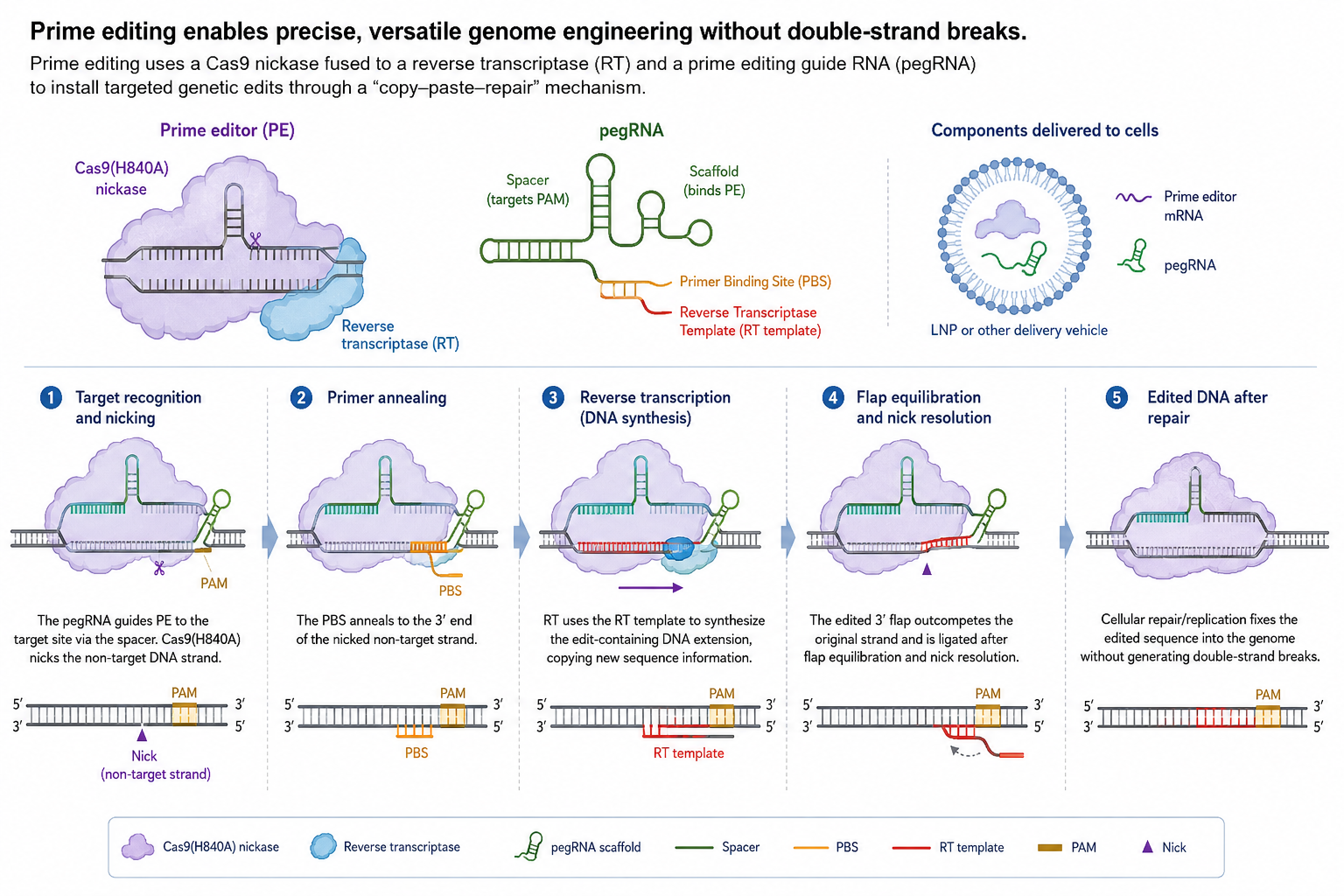
Prime editors have shown preliminary clinical efficacy in treating Chronic Granulomatous Disease (CGD)4. However, like all current prime editing clinical programs, these results stem from an ex vivo approach: patient cells are harvested, edited outside the body, and reinfused. This limits applicability to diseases affecting cell types that can be collected and returned, imposes significant manufacturing complexity, and limits scalability.
The use of adeno-associated viruses has been previously explored for in vivo treatment; their packing capacity and immunogenic risks have prevented clinical success. Lipid nanoparticles (LNPs) have previously served as a promising non-viral delivery vehicle for a variety of therapeutics, such as CAR-T. Recent work has shown LNP-delivered prime editors have achieved transient production of PE protein and potent editing efficiency in the murine liver5. By encapsulating editor mRNA, pegRNA, and/or ngRNA into separate LNPs, single-dose editing efficiency comparable to the standard achieved by AAV-based methods can be demonstrated in vivo.
The components of the prime editing technology are delivered in the form of mRNA. Typically, the editor RNA encodes an nCas9 fused to a reverse transcriptase (RT), while the pegRNA unifies the spacer sequence, primer binding site (PBS), and the reverse transcriptase template (RTT) describing the desired modification. Every mRNA component of a prime editor system must satisfy a demanding set of simultaneous constraints. It must fold correctly. It must resist degradation by cellular exonucleases long enough to produce sufficient protein. It must avoid triggering innate immune responses that would blunt expression or cause toxicity. And it must do all of this while encoding a specific amino acid sequence that cannot be altered.
This is the gap that mRNAutilus was designed to close.
mRNAutilus: AI-Designed mRNA for High-Performance Gene Editing
In our recent mRNAutilus preprint6, we pushed this idea further by designing full-length, optimized PEMax editor mRNAs for sustained expression in human cells and successfully showed improved editing efficiency over commercial and other AI-based alternatives (Figure 2). With mRNAutilus, a language model capable of multi-property, reward-guided de novo mRNA design, we demonstrated the ability to design durably expressing mRNAs for treating infectious diseases and others with potential therapeutic applications.
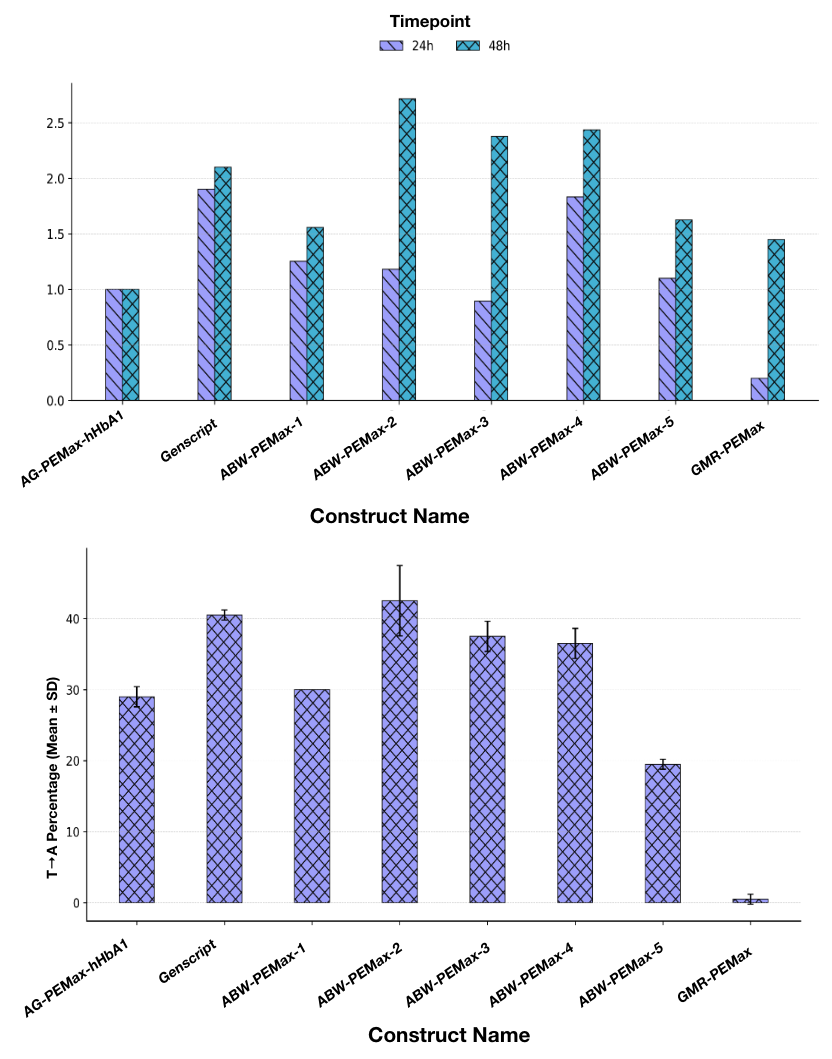
Notably, this data was collected from mRNAs designed zero-shot. In other words, the sequences were designed by mRNAutilus in seconds following specification of the intended amino acid sequence and immediately ordered for evaluation in vitro. Therapeutic programs centered around delivering any gene editing payload could benefit from a boost in sustained editing payload expression from the get-go, circumventing the need to continually tamper with the payload construct.
What This Means for Your Gene Editing Program
If your program depends on delivering a gene editing payload — whether a prime editor, base editor, Cas nuclease, or any other protein-encoding mRNA — the expression performance of that mRNA is not a secondary concern. It is a primary determinant of editing efficiency, therapeutic window, and the dose required to achieve your target effect.
mRNAutilus removes the need to treat mRNA sequence design as an empirical optimization problem solved over months of iterative experiments. It gives programs:
- Higher baseline expression from the first sequence synthesized; no warmup cycles needed
- Faster program progression by compressing the optimization timeline from months to days
- Broad design coverage: The platform handles full-length, complex mRNAs including those encoding large fusion proteins like PEMax
- Zero-shot performance: No payload-specific fine-tuning required before generating high-quality sequences
For prime editing programs in particular, where every increment of editor expression translates directly into editing efficiency and durability of correction, starting with a mRNAutilus-optimized sequence rather than a conventionally codon-optimized one is one of the highest-leverage decisions a program can make at the outset.
Ready to Design Better mRNAs for Your Program?
Whether you are in early-stage discovery, preparing for IND-enabling studies, or re-evaluating the mRNA sequences underlying your current editing payload, we can help you get more performance from every experiment — starting with the first one.
Get in touchFind out what optimized mRNA design looks like for your specific payloadCitations
- Porteus MH, Carroll D. Gene targeting using zinc finger nucleases. Nature Biotechnology. 2005;23(8):967–973.
- Mussolino C, Cathomen T. TALE nucleases: tailored genome engineering made easy. Current Opinion in Biotechnology. 2012;23(5):644–650.
- Jansen R, et al. Identification of genes that are associated with DNA repeats in prokaryotes. Molecular Microbiology. 2002;43(6):1565–1575.
- Gori JL, et al. Prime Editing for p47phox-Deficient Chronic Granulomatous Disease. New England Journal of Medicine. 2025;394:1195–1203.
- Jiang AY, et al. Efficient prime editing in vivo and in vitro using lipid nanoparticles. Nature Nanotechnology. 2026:1–14.
- Patel S, et al. mRNAutilus: Multi-Objective-Guided Discrete Generation of mRNA with Optimized Therapeutic Properties. arXiv preprint arXiv:2605.31296. 2026.